Skip to Content
In
recent years, Lost Foam Casting (LFC) has emerged as one of the most
talked-about advancements in modern foundry engineering. With its coreless
geometries, high dimensional accuracy, minimal machining allowances, and up to
99% sand reclamation, the advantages are undeniable.
However, at J K Engitech Pvt. Ltd.
(JKEPL), they believe in engineering honesty over aggressive sales pitches: Lost
Foam Casting is not a universal replacement for every casting process.
The Reality of Global Foundry Trends
A common misconception in the industry is
that modern technology will render traditional methods obsolete overnight.
Looking at global manufacturing hubs like China where LFC has matured over
decades Lost Foam has not replaced conventional molding methods.
Instead, High-Pressure Green Sand lines,
Resin-Bonded (No-Bake) systems, and Shell Molding continue to coexist and
expand alongside LFC. Each process serves distinct operational volumes,
component geometries, and metallurgy profiles. Choosing LFC purely because it
is cutting-edge without evaluating the geometric and economic fit of the
component often leads to underutilized capacities and extended payback periods.
Understanding the True Suitability of
LFC
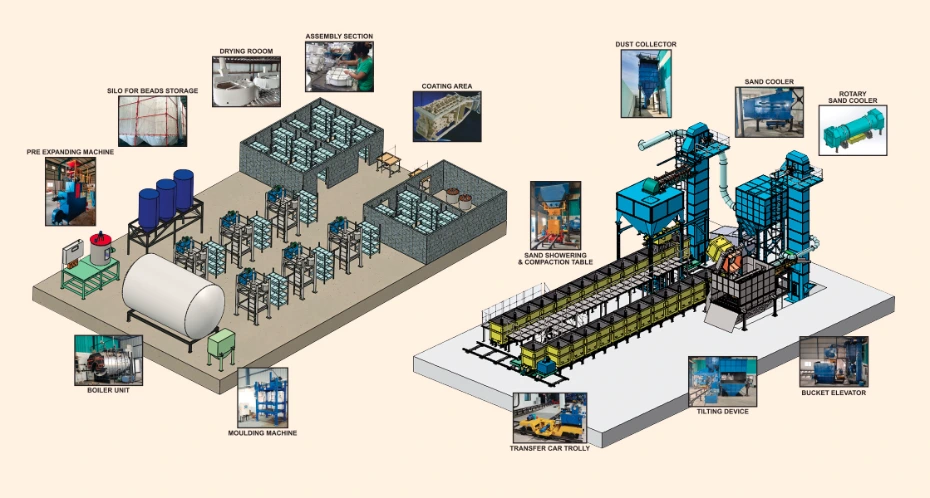
Before investing in a turnkey Lost Foam
setup, foundries must evaluate their product portfolio against specific
criteria:
Geometric Complexity: LFC shines
brightest when consolidating multiple sub-assemblies into a single
casting, eliminating complex internal cores, or executing zero-draft
passages.
Machining Reduction: The commercial
viability of LFC increases significantly when near-net-shape accuracy
saves substantial CNC cycle time and tooling wear.
Volume and Repeatability: High
batch consistency makes pattern tooling and bead-expansion parameters
highly cost-effective.
Alloy & Metallurgy Compatibility: Certain cast iron, ductile iron, and aluminum grades yield
exceptional results, whereas specific heavy steel or low-carbon alloys
require specialized process controls to manage gas defects and carbon
pickup.
The Imported Technology Gap vs.
Indigenous Adaptation
Many foreign plant manufacturers
aggressively market LFC turnkey plants with off-the-shelf equipment. However,
Indian foundries frequently encounter major hurdles after commissioning:
Partial Technology Transfer:
Foreign suppliers often deliver machinery without transferring the
fundamental metallurgical and process know-how required for day-to-day
process troubleshooting.
Mismatched Operating Conditions:
Imported setups are rarely tuned to Indian raw materials (foam bead
grades, coating rheology, ambient humidity variations, and local sand
characteristics).
Delayed Handholding: When process
defects occur, reliance on overseas technical support creates costly plant
downtime.
The JKEPL Advantage: Indigenous Mastery
Since 2010
JKEPL began researching and prototyping LFC
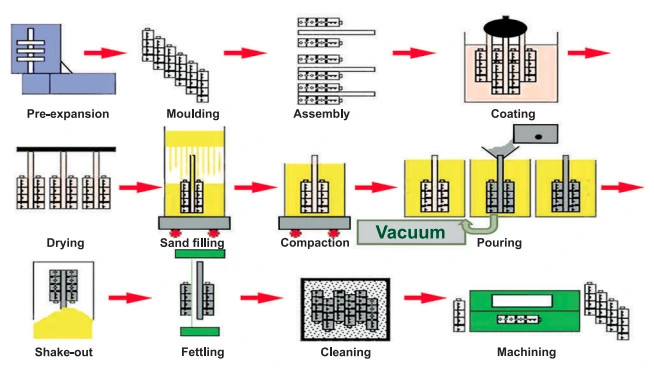
in 2010. Over the past 16+ turnkey installations, we have adapted every stage
of the process from pattern molding and coating drying cycles to
three-dimensional compaction and vacuum-assisted pouring specifically for
Indian foundry conditions.
Proven Technical Network: Our
ecosystem includes indigenous foundry technocrats and metallurgists with
6+ years of active, hands-on production experience in Indian LFC plants.
Faster Process Ramp-Up: We assist
our clients with tooling design, coating optimization, and parameter
setting, drastically shortening the learning curve.
Objective Advisory: We evaluate
your component drawings before recommending a line. If your product is
better suited for High-Pressure Green Sand or No-Bake systems, we
recommend the process that genuinely serves your bottom line.
Engineering Growth on Solid Fundamentals
Lost Foam Casting offers immense
competitive advantages when matched with the right components. Successful
adoption requires an engineering partner who understands both the machine
design and the metallurgical process.
Consult JKEPL's engineering team to evaluate your casting portfolio, assess
process feasibility, and determine the optimal molding technology for your foundry's
long-term growth.
*****